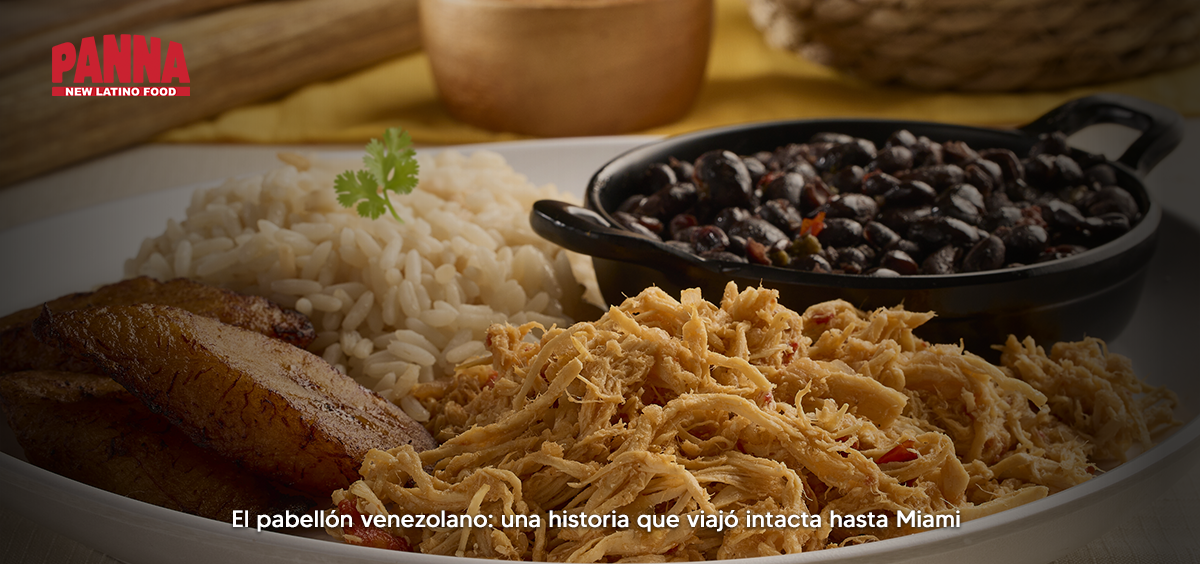
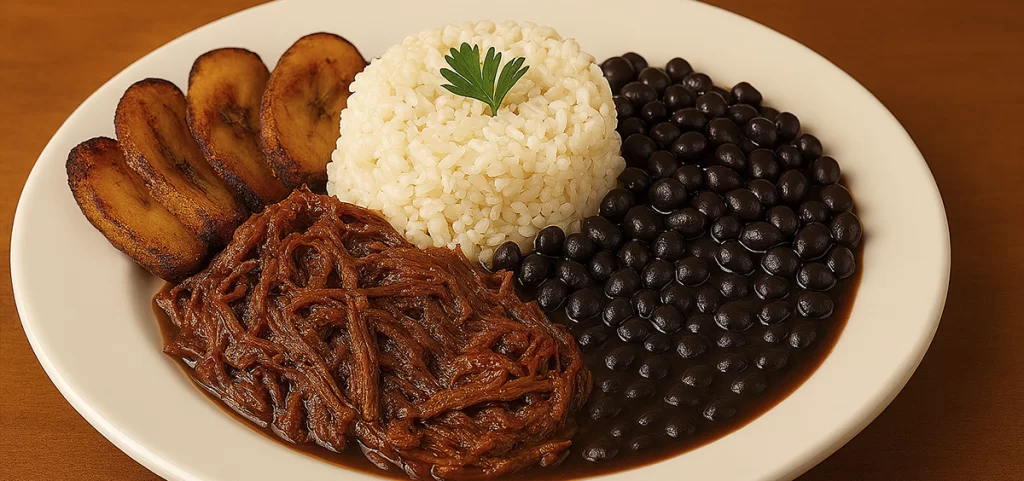
The pabellón criollo reaches the plate with the authority of a dish that has represented an entire country for centuries: white rice, black beans, shredded beef, and fried sweet plantains—four flavors that, together, tell the story of Venezuela. It is the dish that appears on the menu of any restaurant, the one you order at lunchtime during the workday, or simply when you need to reconnect with something familiar. Because pabellón is not just a recipe: it is a custom, a meeting point, and a way of saying, “We are here.”
A STORY BORN FROM THE MIX
The origin of pabellón criollo dates back to colonial times, when enslaved people and peasants mixed the previous day’s leftovers into a single ration: rice, beans, meat, and plantains. From this combination born of necessity, a national symbol emerged, and each ingredient carries its own meaning. The rice represents unity, the black beans represent constancy, the shredded beef represents hard work, and the tajadas (sweet plantains) provide that sweetness that balances life. Together, they tell the same story as our people: a blend of heritage, resilience, and flavor.
Over time, pabellón became the most representative dish of Venezuela. There is no local menu without it, and no office lunch feels complete until that white plate arrives with its four corners perfectly served.
THE FLAVOR OF THE VENEZUELAN ROUTINE
Although many associate it with grand celebrations, pabellón is part of the daily routine. It is eaten during the week, at lunchtime, when the body asks for something substantial and the soul needs a break. In homes, the aroma of the sofrito mixes with freshly made rice and the sound of oil frying the tajadas. In restaurants, you hear that classic line: “A pabellón, please!”—like someone asking for a breather in the middle of the rush. Pabellón is both routine and ritual because it has something that calms and something that excites. You know that what is coming is not just food: it is familiar territory, a flavor learned since childhood.
THE ART OF “ESMECHAR” AND THE FLAVOR OF THE BEANS
Preparing pabellón has its own technique. The meat is not simply crumbled; it is esmechada, as we say in Venezuela. First, it is tenderized with seasonings, then patiently shredded by hand and sautéed in a sofrito that gives it its characteristic color and scent. The black beans, for their part, are the heart of the dish: they are cooked slowly with onion, garlic, ají dulce (sweet pepper), a touch of cumin, and that drizzle of oil that only an expert “bean-maker” knows how to measure. The rice must be fluffy (suelto), and the tajadas golden—neither soft nor burnt—at that exact point that smells like home.
PABELLÓN IN MIAMI: A FLAVOR THAT SURVIVES
When Venezuelans arrived in Miami, the pabellón arrived with them. A pot might not have fit in the suitcases, but the memory of the flavors and the secrets of every home certainly did. Today, it is common to see families still preparing it the same way, even if ingredients change slightly according to what is available. The truth is, pabellón does not adapt; it stands its ground. Because beyond the recipe, what remains is the intention to preserve the original flavor. Here, amidst the city noise and the fast pace of life, this dish remains a refuge. Every time someone prepares or orders it, they reaffirm their identity, their roots, and their memory.
AT PANNA, PABELLÓN TASTES LIKE HOME
At PANNA, the pabellón is cooked as it should be: with respect, time, and heart. The black beans are prepared with a homemade sofrito, the meat is shredded and slow-cooked, the rice is served white and fluffy, and the golden tajadas crown the plate, just as tradition dictates. For us, pabellón is not just another item on the menu; it is a promise. It is a way of keeping alive that flavor that all Venezuelans have engraved in our memories. That is why every pabellón that leaves our kitchen carries the soul of the one who prepares it and the pride of the one who eats it.
A FLAVOR NEVER FORGOTTEN
The pabellón criollo has traveled with us wherever we go… it is a testimony to our history and a companion in every reunion. That is why, when we taste it, we don’t just remember a flavor: we remember an entire life around the table. If you are in Miami and miss that exact moment when everything comes together—the beans, the meat, the rice, and the tajadas—come to PANNA. Here, the pabellón doesn’t just nourish… it makes you feel like you are still at home.