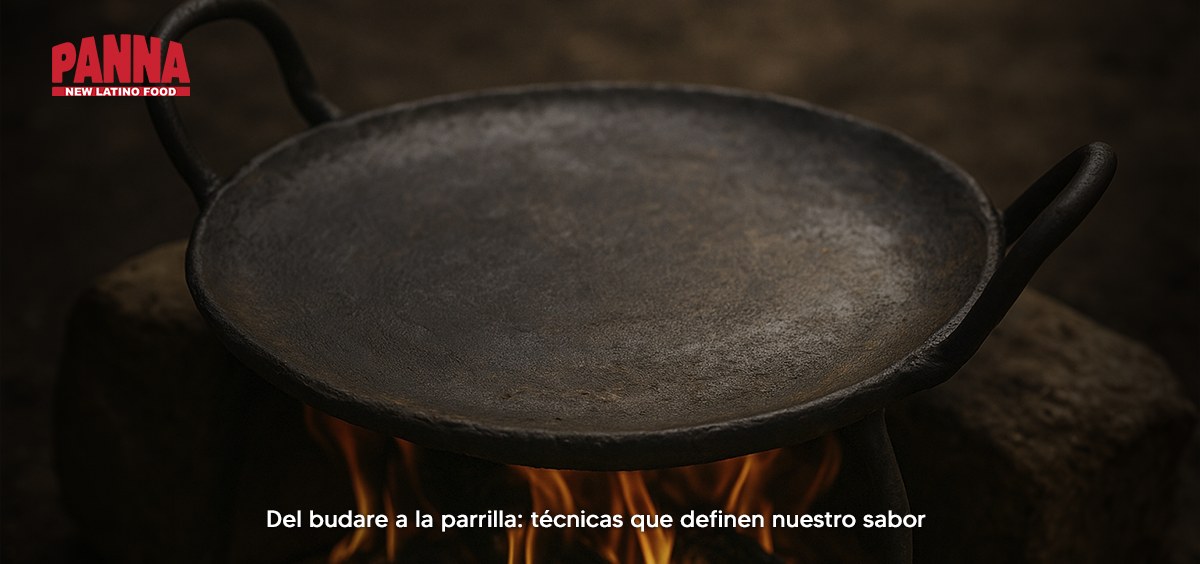
Venezuelan cuisine is also told through its tools, because there is no hallaca without a plantain leaf, no arepa without a budare, and no family Sunday without a lit grill. Each cooking technique holds centuries of history, migrations, and cultural heritages that remain alive at the table today. And while ingredients are essential, the flavor is often defined by how they are prepared—in that direct contact with fire that provides character, texture, and memory.
In Venezuela, the budare and the grill are not mere kitchen utensils; they are symbols of identity that speak to us of the countryside and the city, of indigenous tradition and cultural blending, of innovation and resistance. To talk about them is to travel the map of our country and understand why we keep returning, time and again, to those smoky, toasted, and golden flavors that define us.
THE BUDARE: ANCESTRAL HERITAGE THAT PERSISTS
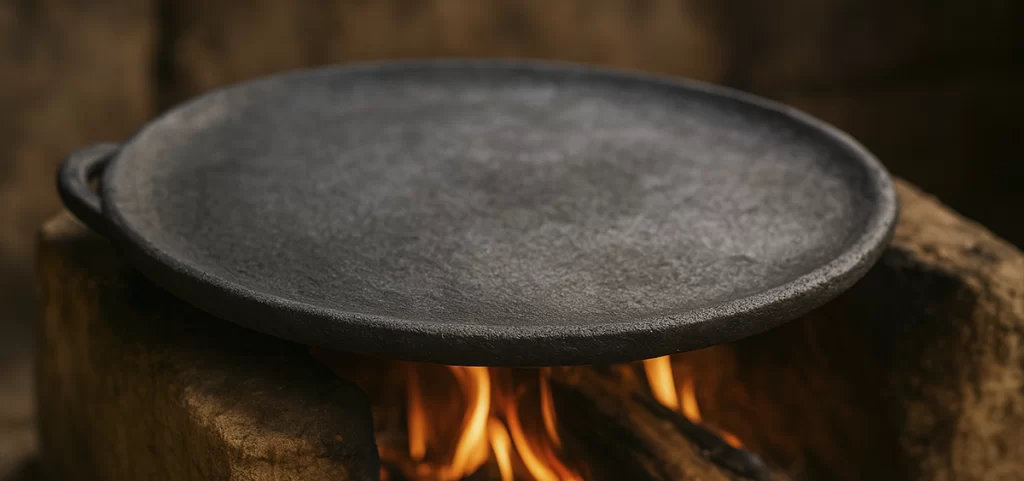
The budare is one of the oldest utensils in the Venezuelan kitchen. Its origin dates back to indigenous communities who used it to cook arepas, casabe, and corn breads. Traditionally made of fired clay—and later of cast iron or steel—this flat disc is placed over the fire to become the stage for one of the most important rituals of our gastronomy: the direct cooking of the dough.
Colonial chronicles already mentioned the budare as a fundamental part of the kitchens in the Caribbean and the northern region of South America. In Venezuela, it was first associated with casabe, a staple food of original peoples made from grated and pressed bitter yuca. Later, with the expansion of corn, it became the perfect surface to cook arepas—those round patties that are now our daily bread.
The budare is not just a tool; it is a cultural bridge. Its versatility has kept it relevant: it is used to make cachapas, bollos, empanadas, and even thin meats that sear quickly to absorb the flavor of the fire. In many homes, it still occupies the center of the kitchen as a silent witness to family breakfasts and improvised snacks.
THE GRILL: THE RITUAL OF FIRE
If the budare represents intimacy and daily life, the grill (la parrilla) represents celebration and collective gathering. Lighting the charcoal, waiting for the perfect ember point, and placing the meats, sausages, or vegetables is an act that summons family and friends. The Venezuelan grill differs from others in Latin America because it is not a solemn ritual or an art of exclusive cuts, but a shared experience where everything fits and everyone participates.
In our country, the grill is the heritage of multiple influences—from Argentine and Uruguayan roasts to Brazilian cuts or the criollo flavors of the Plains (Llanos). But in Venezuela, we have adapted it to our style with our own marinades, local sides, and, above all, a festive atmosphere where music, conversation, and ice-cold beer are as important as the fire itself.
The flavor of the Venezuelan grill comes from the mix of charcoal or wood smoke and criollo seasonings: garlic, onion, ají dulce, oregano, cumin, and even touches of beer or papelón added to the meats to give them a signature seal. The resulting platter, filled with chorizos, blood sausages (morcillas), chicken, ribs, and tenderloin, is always accompanied by arepas grilled on the same fire, guayanés cheese, and guasacaca—the green sauce that is an emblem of our identity.
TWO TECHNIQUES, ONE SPIRIT
Although the budare and the grill represent different contexts, both respond to the same spirit: direct contact with fire. On the budare, the dough transforms into bread in just a few minutes of heat, acquiring that light crust that holds the softness of the corn inside. On the grill, the meat and vegetables are infused with smoke and caramelize on the surface, preserving the juices and enhancing the flavor.
Both utensils are witnesses to our gastronomic memory. The budare recalls indigenous and peasant roots, while the grill expresses criollo sociability and cultural openness. In both cases, the important thing is not just what is cooked, but what is shared around it: the stories, the silences, the laughter, and the feeling of home.
FROM THE COUNTRYSIDE TO THE CITY, FROM VENEZUELA TO MIAMI
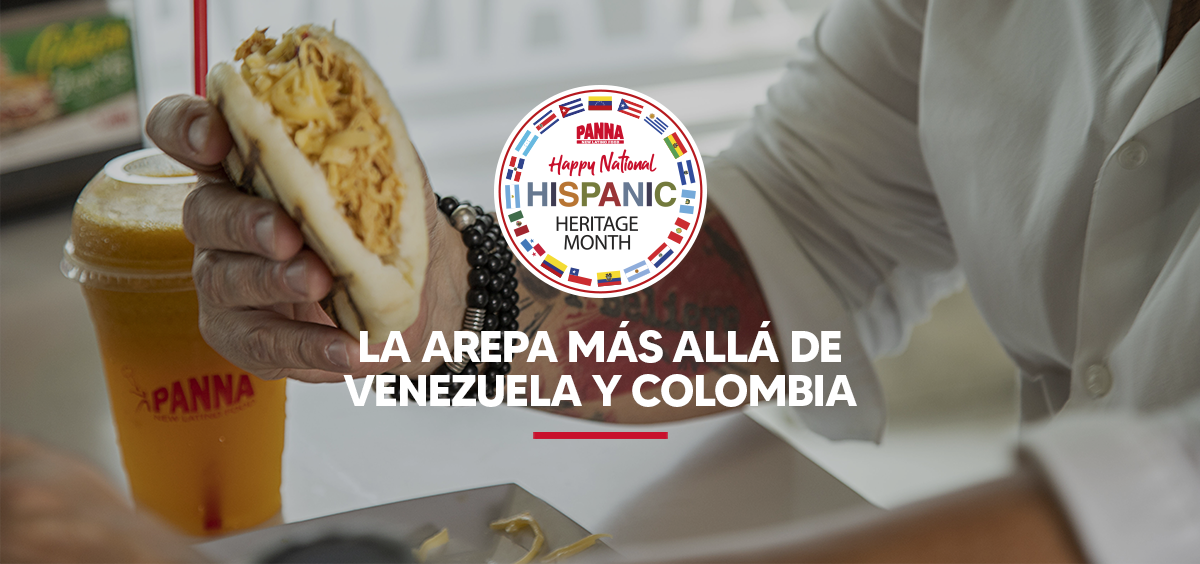
In Miami, where Panna has become a meeting point for those looking for the flavors of home, these techniques remain alive. The budare, though often replaced by modern griddles, remains the heart of our arepas. In our restaurants, the aroma of toasted corn on the griddle awakens immediate memories in those who grew up in Venezuela and becomes a discovery for those trying an arepa for the first time.
The grill, for its part, has integrated into the city’s daily life as an extension of Venezuelan culture. There is no celebration, large or small, where an improvised grill doesn’t appear, nor is there a Sunday where Miami’s parks aren’t filled with families and friends gathered around the embers. It is there where tradition is reinvented, with a mix of Latin flavors ranging from Argentine chorizos to Venezuelan arepas, along with side dishes from other cultures found in this diverse city.
AT PANNA: FLAVOR MADE BY FIRE
At Panna, we know that authentic flavor is born from respect for the techniques that define us. That’s why our arepas are cooked on griddles that recreate the spirit of the budare, achieving that perfect combination of a golden crust and a soft center. And when we talk about the grill, we ensure that every meat is well-marinated, every side dish stays fresh, and every arepa accompanies the meal with the exact warmth of the embers.
Here, the budare and the grill are not nostalgia; they are the present. They are part of a menu designed for those who want to reconnect with their roots and also for those who wish to discover the best of Venezuelan and Latin American food in Miami.
CONCLUSION: THE FLAVOR OF THE FIRE THAT UNITES
The budare and the grill are much more than kitchen utensils; they are memory, identity, and community. They represent the union of the intimate and the collective, of corn and meat, of the countryside and the city, of tradition and modernity. In every toasted arepa and every grilled meat, there are centuries of history and an invitation to share.
So, the next time you come to Panna, think about this: it is not just a meal you are tasting, but a legacy of fire that brings us all together.