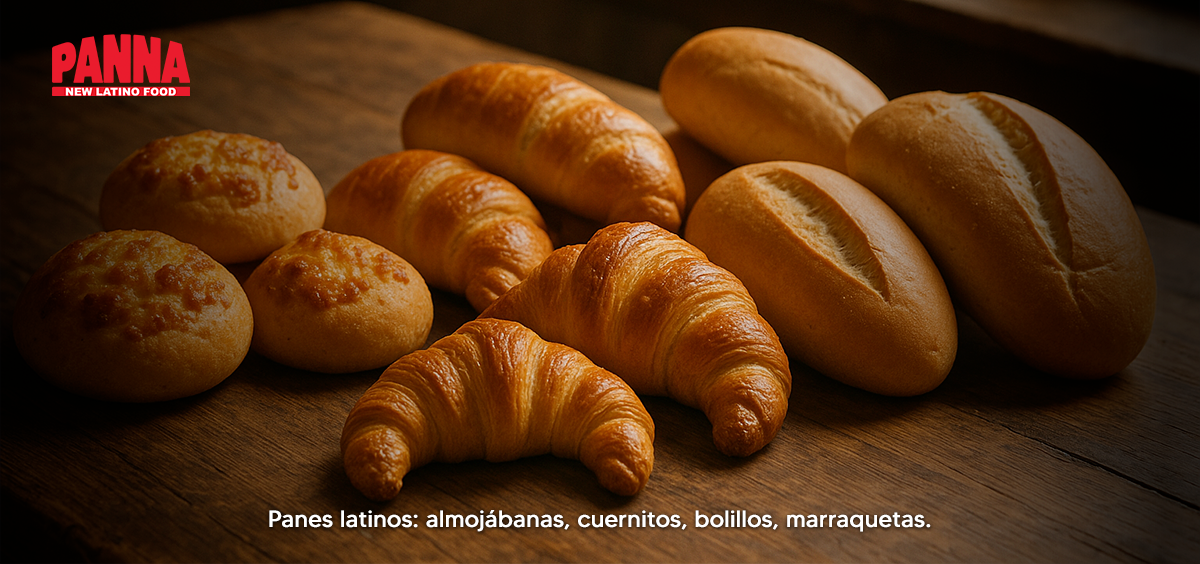
Latin Breads: There are scents that travel, and that of warm bread, fresh out of the oven, is one of them. It doesn’t matter if you are in Caracas, Bogotá, Santiago, or Mexico City: stepping into a bakery and catching that aroma can transport you back home, to childhood, to a breakfast with butter melting without a rush.
Across Latin America, bread is more than just food… it is companionship; it is routine. It’s that silent bond renewed every day when someone walks into a bakery and asks: “Is there any bread from this morning?” Every country has its own shapes, names, doughs, and rituals, but they all share something in common: these breads are witnesses to daily life. Today, we travel with our palates to discover four breads that, while not Venezuelan, are very similar to the things we love. Because dough, like nostalgia, is kneaded everywhere.
ALMOJÁBANAS: BREAD AND CHEESE, MERGED INTO ONE
The almojábana is a small baked jewel widely found in Colombia, Puerto Rico, Panama, and parts of Central America. Round, soft, and with a lightly golden crust, this roll has a peculiarity that makes it unforgettable: it is made with cheese right inside the dough.
Depending on the country and region, it may contain cassava starch, pre-cooked cornmeal, or wheat flour. But the common denominator is the grated cheese—preferably salty—which melts with the starch to create a moist, light crumb with a deep flavor. In Colombia, for example, it is the star of country breakfasts, displayed in glass cases next to coffee and sold in baskets covered with cloth napkins. It’s the bread eaten standing in a plaza or sitting on a bench, watching the morning go by. For the Venezuelan palate, the almojábana recalls our sweet arepas with cheese, anise bollitos, or Andean cheese bread, though with a more tender character. Above all, it connects us to that very Latin American idea that bread and cheese are not just combined—they are integrated from the start.
CUERNITOS: THE CRESCENT THAT SHINES IN THE SOUTH
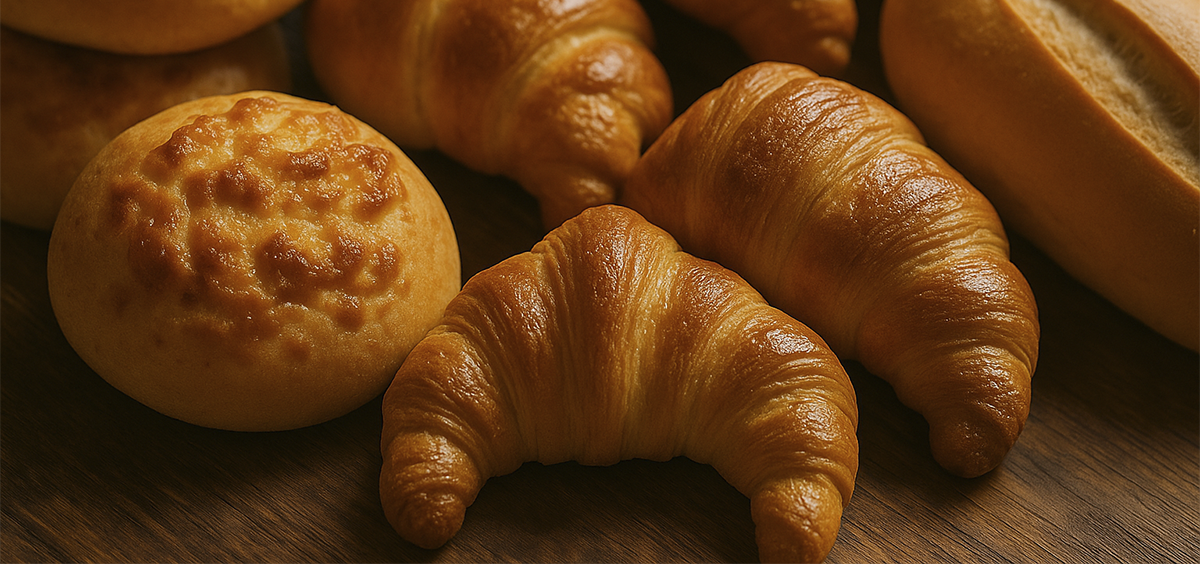
The cuernito, also known as a medialuna, is a crescent-shaped bread consumed with devotion in Argentina, Uruguay, and Paraguay. At first glance, it might be confused with a European croissant, but make no mistake: the cuernito has its own soul.
There are two versions: de manteca (butter-based, softer, and slightly sweet) and de grasa (shortening-based, firmer, less sweet, and intense in flavor). Both are part of that sacred Southern Cone ritual known as “breakfast with medialunas”: a tray of cuernitos and a café con leche served in a generous mug. Cuernitos aren’t just for the morning; they accompany chats, after-dinner talks, romantic dates, rainy afternoons, office days, and school snacks. They are the bread of daily affection. For a Venezuelan, the experience can be surprising. The cuernito is more compact than a cachito and less sweet than a golfeado, but it offers the same warmth. And like all good bread, its flavor improves when shared.
BOLILLOS: FIRMNESS AND FLAVOR ON THE MEXICAN TABLE
The bolillo is Mexico’s most emblematic bread. It is baked daily in almost every bakery in the country, and its oval shape, with a longitudinal slit in the center, makes it unmistakable. It has a thin but firm crust, ideal for sandwiches (or tortas, as they are called in Mexico), and a white, fluffy, airy crumb.
It tears easily, holds moist fillings well, and is an integral part of many dishes. The bolillo accompanies breakfast with cream or beans, lunch with stews or mole, and is also the bread served with broths and pozoles. In difficult times, it has also been a symbol of resilience: cheap, durable, and filling. For many Venezuelans migrating to Mexico, the bolillo becomes a substitute for the pan francés or pan gallego, but its own value is quickly recognized. It’s not bread for “accompanying”—it’s bread for “action.” It is stuffed, drenched in sauce, and eaten on the go. It doesn’t crumble; it stands up to whatever comes its way.
MARRAQUETAS: A CRUNCH OF TRADITION IN CHILE
The Chilean marraqueta is likely one of the breads with the strongest “sonic identity” in Latin America. Crunchy on the outside with a soft white crumb, it is presented as a double unit, divided into two equal parts by a precise indentation.
When you bite into it, it makes a sound. That crunch is almost a registered trademark of Chilean baking. The marraqueta accompanies breakfasts with palta (avocado), partners with cazuela stews, is spread with butter, or filled with ham. In many homes, if there is no marraqueta, there is no breakfast. To a Venezuelan, it may seem like a mix between French bread and pan gallego, but one taste is enough to discover its own character: light, honest, crispy, and everyday.
BREADS THAT CROSS PATHS AND EMBRACE
Across the continent, there are thousands of breads: pan de yuca, pan de bono, pan campesino, braided bread, sweet bread, homemade bread—and each has its own story, recipe, and texture. But they all have something in common: they are meant to be shared.
- Bread is broken.
- Bread is given as a gift.
- Bread accompanies news and celebrations.
- Bread is brought to someone’s house as a sign of affection.
- Bread can be eaten alone… but never with sadness.
That’s why, when a Venezuelan tries an almojábana or a bolillo, they might miss the pan francés from their usual bakery. But they might also discover a new way to feel at home.
AT PANNA, WE ALSO HAVE BREADS THAT TELL STORIES
At PANNA, we know that bread is not just something you bake. It is something you feel. That’s why our trays are filled every day with golfeados with papelón and cheese, soft cachitos with ham, and, during Christmas, pan de jamón filled just like the ones shared at family dinners.
We also bake fresh baguettes daily, perfect for breakfasts with perico eggs, guayanés cheese, or grilled ham. And, of course, the quintessential Venezuelan bread: the arepa, the absolute queen of our identity. Round, versatile, generous, served with butter or filled however you like. Because if anything defines us, it’s that we know how to turn dough into an act of love.