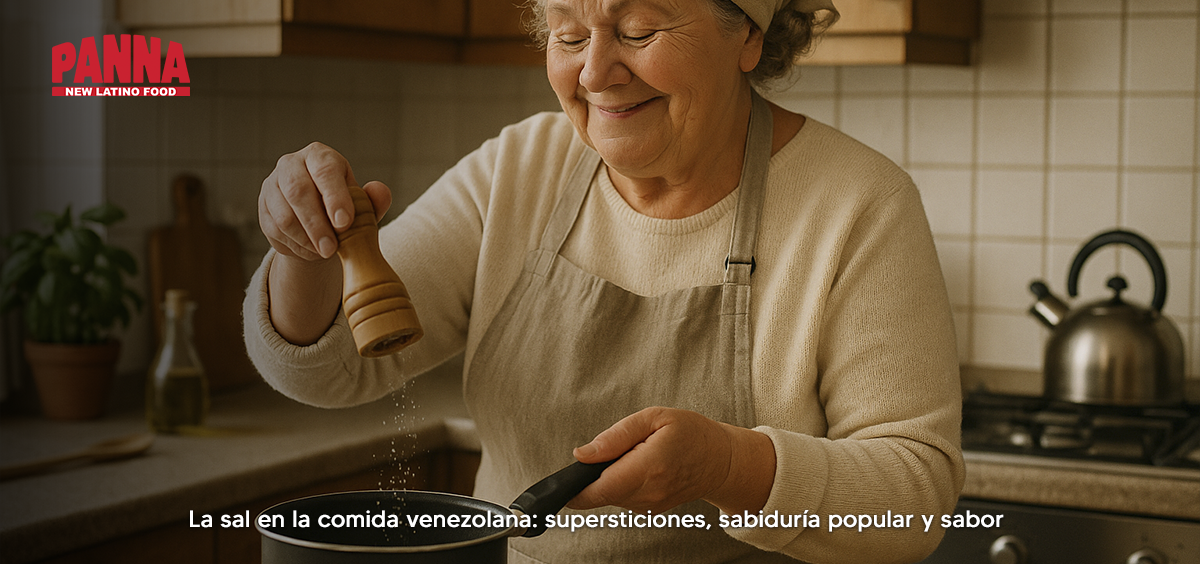
It is one of the simplest and most common ingredients in any kitchen in the world… but in Venezuela, salt is not just salt: it is a symbol, a belief, a mystery, and a flavor. No recipe begins without a pinch between the fingers or a dash falling into the water. There is no grandmother without her exact method, nor a mother who hasn’t taught that salt is added “when it starts to boil” or “after it softens.” And no, it is not just a matter of taste. Around this white seasoning revolves an entire universe of criollo superstitions, proverbs, oral traditions, and accumulated wisdom passed down through generations. Today we want to explore its history, its uses, and its almost ritualistic power in Venezuelan cuisine.
AN ANCIENT INGREDIENT THAT ACCOMPANIES US FROM CHILDHOOD
Salt is one of the oldest minerals used by humans as a preservative, flavor enhancer, and symbolic element. In the territory that is now Venezuela, the use of salt was known since pre-Columbian times. Indigenous peoples such as the Warao, Pemón, and Kariña extracted vegetable salt or used ashes from salty plants to season and preserve food. Later, with the arrival of colonizers, marine salting methods were introduced, particularly in coastal areas like Araya, Falcón, and Sucre. From then on, salt became a structural part of the diet, both for cooking and for preserving meats, fish, pickles, and sausages.
In daily life, salt is in everything: in the sancocho, in the sofrito for the rice, in the seasoning of the black beans… even in the way we cure queso llanero or let capers mature. But it’s not just about technique; it’s also about what is believed, respected, and repeated.
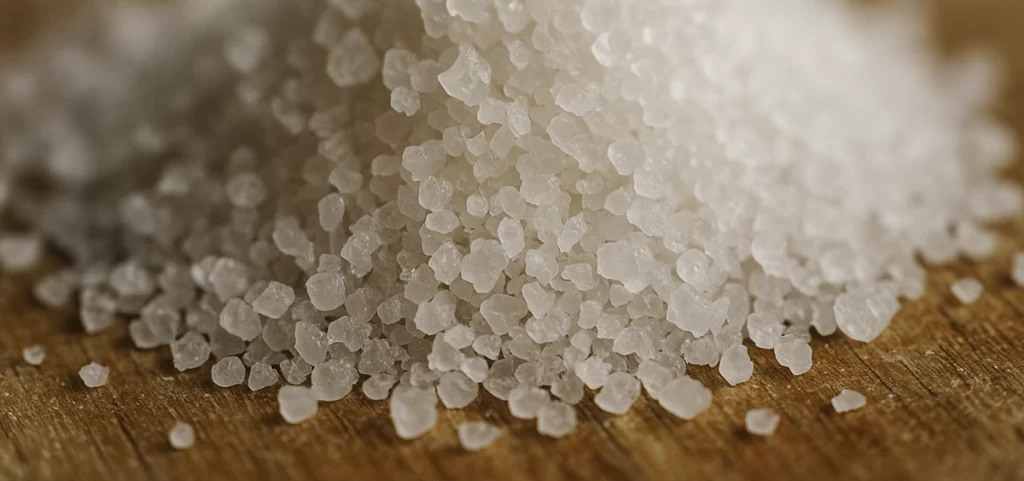
WHAT IS SAID ABOUT SALT
In many Venezuelan homes, salt is not passed from hand to hand: it is left on the table. They say that if it is handed over directly, it can “salt” the relationship, bringing entanglements or arguments. This belief, inherited from Spanish tradition and shared with other Spanish-speaking countries, remains alive in households of all kinds.
But what is truly important, regardless of superstitions, is that each region has its own ways of salting. In the Andes, cooking tends to use salt in moderation, prioritizing herbal flavors or substantial broths. In the East, however, many fish or seafood dishes use coarse salt or sea salt for curing or marinating. In the Plains (Llanos), it is common to salt meats before putting them on the fire, especially in the case of a criollo roast or carne en vara. There are also those who still use pink, black, or garlic salt as a modern variation… but the base remains the same: a touch that awakens the flavor and elevates the dish.
Seasoning is an art taught without recipes. It is learned by watching and tasting. It is not measured in tablespoons, but in inherited intuitions. And in that subjectivity lies the magic: what is “perfect” for one may be “too salty” for another… and yet, both can be right.
WHEN SALT IS MISSING, IT IS FELT
Sometimes we don’t realize its importance until it’s missing. A meal without salt can be perfectly cooked, well-presented, and made with love… but it will still be bland. The opposite also happens: if there is too much, everything is ruined. The balance of salt is a perfect metaphor for Venezuelan cuisine: simple yet profound; familiar yet complex; close yet demanding. Hence, the phrase “it lacked salt” doesn’t just refer to the seasoning, but to the soul of the dish. Because without that touch, there is no memory, no sazón, no home.
SALT AT THE TABLE: MORE THAN A DETAIL
In many Venezuelan homes, salt at the table wasn’t common until guests arrived. The salt shaker appeared so that everyone could adjust to their liking, though deep down it was expected not to be needed. Because if the dish was well-made, it shouldn’t need anything else.
Today, in modern times, we use different types of salt for different dishes. Coarse salt for grills, sea salt for fish, low-sodium salt for those who require it. But the intention is the same: to enhance, accompany, and transform without eclipsing. Perhaps that is why, in the collective imagination, salt is so symbolic. It is associated with flavor, yes, but also with luck, abundance, and relationships with others.
AT PANNA, WE SEASON WITH WISDOM
At PANNA, we understand that salt is not just a technical ingredient, but a responsibility. That’s why every dish is seasoned with balance, respecting the original flavor of each ingredient without disguising or overshadowing it. We don’t use salt to cover mistakes, but to exalt virtues. Our sofritos are made in-house, over low heat and with the right amount of salt, so that every bite has that familiar flavor recognized with your eyes closed. Here, the salt isn’t seen… but it is felt. And it is that invisible touch that makes you say: “This tastes like home.”
CONCLUSION: BETWEEN FLAVOR AND SYMBOLISM
Salt, though it may seem minimal, has an immense place in our gastronomy. It is part of the taste, yes, but also of the beliefs, the phrases we repeat, and the rituals we don’t question. It is living history in every meal. And although it may not be noticeable at first glance, its presence—when it is just right—changes everything. Perhaps that is why, when the food is tasty, we say with a smile: “It has just the right amount of salt!”